
CREATINE: Not Just For Bodybuilders!
For the longest time, I thought of creatine, if not exclusively, at least primarily as a bodybuilder's supplement. I knew about its use for building muscle, improving strength and supporting athletic performance, but it simply wasn't something that had particularly captured my attention.
That began to change over the past several months.
A client recovering from a traumatic brain injury mentioned creatine to her physical therapist and asked whether she thought it would be a good idea for her. The therapist agreed and then added, "Frankly, I think everyone should use it."
That got my attention.
Not long afterward, a gentleman in his eighties who was using creatine for muscular support told me that he had noticed something unexpected: his thinking seemed clearer.
At that point, I decided it was time to do some digging into creatine and brain health, and I was pleasantly surprised.
WHY HAD I OVERLOOKED CREATINE?
There was actually another reason I had never paid much attention to supplemental creatine.
I have long used an indium supplement myself and in my practice. Based upon the indium literature and teaching I had worked with, I understood indium to greatly increase creatine recycling and was cautioned against simultaneously adding supplemental creatine because of concern about creating an excessive creatine load.
I once specifically asked Dr. Joseph Marion, ND, author of Indium: New Mineral Discovery of the 21st Century, how to safely transition someone from indium to creatine, or vice versa. His recommendation was to allow a full eight days between them. Regarding the effects of combining indium with creatine, he writes: "CAUTION: AVOID taking Indium with Creatine, which uptake raises Creatine 500% to toxic level. Allow Indium to rebuild normal glandular output of youthful days, without taking hormones from outside the body."
Consequently, creatine supplementation simply wasn't part of my usual toolkit, and I thought if indium raises creatine that emphatically, then whatever my creatine needs might be must be being met!
But let's learn more.
WHAT IS CREATINE, AND WHAT DOES IT ACTUALLY DO?
Creatine is a naturally occurring compound made from the amino acids arginine, glycine and methionine. Our bodies manufacture it, and we also obtain it primarily from meat and fish.
Most of the body's creatine is stored in skeletal muscle, which helps explain its longstanding association with exercise and bodybuilding.
Its fundamental job, however, is much broader: creatine helps cells maintain a readily available supply of energy.
Our cells run on ATP, adenosine triphosphate. When ATP releases energy, it becomes ADP. Phosphocreatine can rapidly donate a phosphate group to help convert that ADP back into ATP.
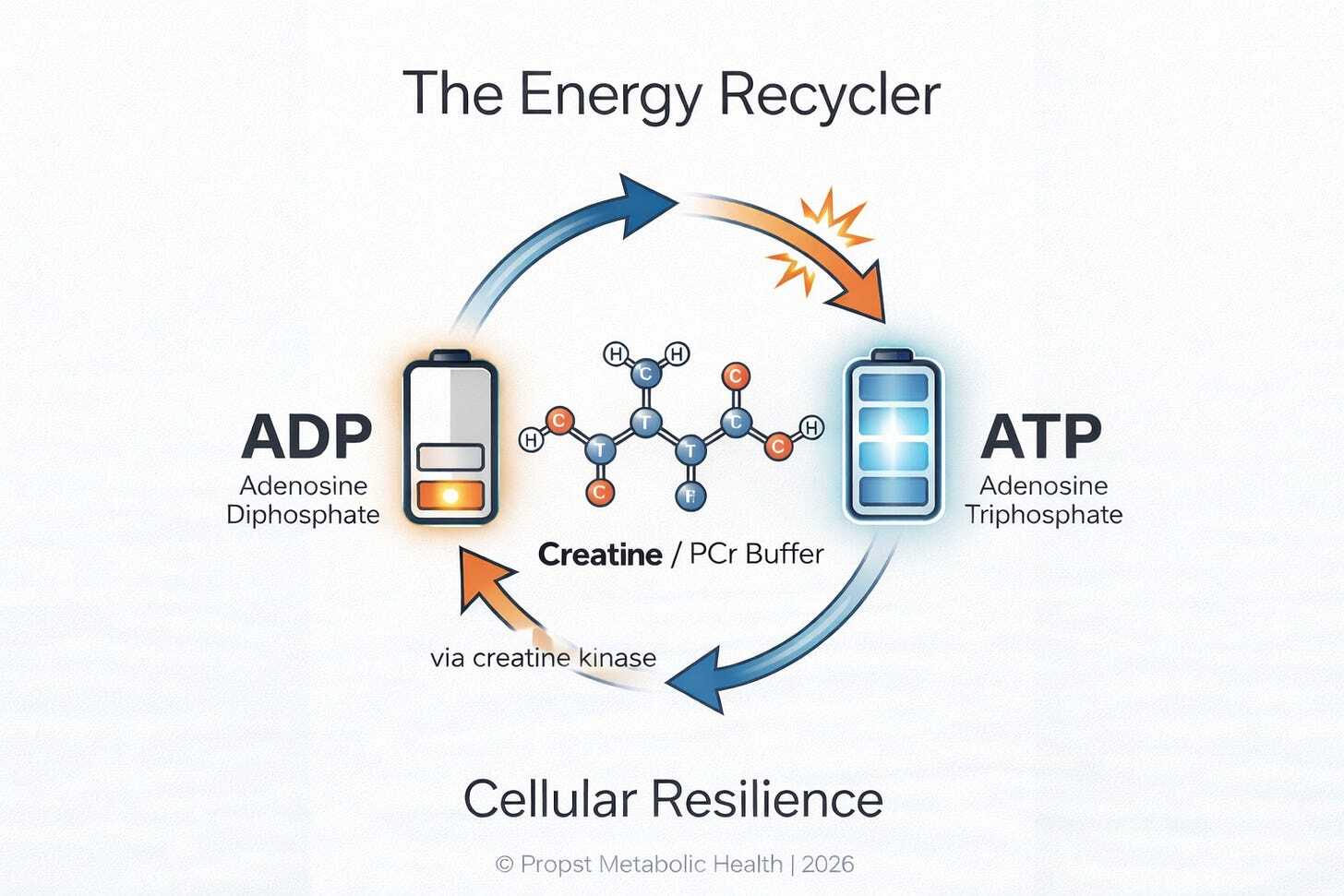
One simple way to think about the creatine-phosphocreatine system is as a rechargeable cellular energy reserve. I have long called myself a "Mitochondriac," so you can see why this understanding was immediately appealing to me!
OF COURSE, MUSCLE STILL MATTERS
Creatine is one of the most extensively studied sports supplements available. In conjunction with resistance exercise, it can help improve strength, power and lean body mass.
As we get older, however, this becomes about much more than athletic performance.
Maintaining muscle helps us maintain mobility, metabolic health, balance, resilience and independence. Age-related muscle loss, or sarcopenia, can eventually contribute to frailty and loss of function. For so much more information on all of this and how to maintain or improve in these areas, please see my several-session series Living Well to Age Well. Here you'll find all kinds of helps, such as specific food and exercise guidelines and, most importantly, why this matters so much and that it can make all the difference when it comes to our enjoyment of life and independence as we age with grace, strength, and flexibility.
BUT WHAT ABOUT THE BRAIN?
Neurodegenerative conditions are at an all-time high in our population today. I was recently invited to speak at a group meeting for a local organization, and, hands down the request for topic was "how to prevent dementia."
Might creatine be of help here?
Perhaps. The brain is an extraordinarily energy-hungry organ, and I've learned that it has its own creatine-phosphocreatine system.
The Brain and Cognitive Skills
Researchers have demonstrated that supplemental creatine can increase brain creatine, although the increase is generally more modest and variable than what occurs in muscle. This has generated considerable interest in whether additional creatine availability can help the brain meet its considerable energy requirements.
Research has investigated creatine in relation to memory, attention, information processing, mental fatigue and cognitive performance.
The results are encouraging in some areas but are not yet uniform enough to say that creatine simply "improves cognition" in everyone. Some systematic reviews have found improvements in measures such as memory, attention time, and information-processing speed, while others have concluded that the evidence remains inconsistent. As I always say, don't hold your breath for definitive studies when it comes to nutrients and their health benefits. The good news is that we know that creatine supplementation will not only help address the energy needs of your muscles, it also influences the energy needs of the brain, and that can only be a good thing.
When the Brain is Under Stress
One particularly interesting area of research involves circumstances in which the brain's energy demands are unusually high or energy availability may be compromised.
Creatine has consequently been investigated in situations such as sleep deprivation, aging and traumatic brain injury.

The TBI connection was especially interesting to me, considering that a client recovering from TBI was one of the people who prompted me to look at creatine again in the first place, AND I have several clients who are dealing with traumatic brain injury. TBI effects can be far reaching and last for decades. It really is something you do NOT want to happen to you!
While creatine is not yet an established treatment for traumatic brain injury, researchers are actively interested in it because disturbances in brain energy metabolism are part of the cascade that follows brain injury, giving creatine a biologically plausible role worthy of further investigation. It makes sense!
Creatine and the Aging Brain
Creatine may be particularly interesting as we age because several things are happening simultaneously.
Aging well involves preserving both physical strength and brain power, and both muscle and brain depend heavily upon efficient cellular energy production.
In this paper, "Creatine monohydrate supplementation for older adults and clinical populations" the authors reviewed creatine monohydrate supplementation specifically in older adults, looking beyond athletic performance to the changes that accompany aging: loss of muscle mass and strength, declining bone health and physical function, metabolic changes, and cognitive decline.
The accumulated evidence suggests that creatine—particularly when combined with exercise/resistance training—can improve or support lean body mass, muscle size and strength, physical function, aspects of bone structure, glucose metabolism, cognition, and memory. The authors also characterize creatine monohydrate as having a good safety profile in older adults.
They propose potential clinical applications in sarcopenia, osteoporosis, frailty, and some metabolic and neuromuscular disorders, although the strength of evidence varies among these applications.
That makes my eighty-something client's observation about clearer thinking - when his primary expectation from creatine was muscular health - especially interesting to me.
CREATINE IN THE DIET

Dietary creatine comes predominantly from animal foods, particularly meat and fish. Plant foods contain very little. For that reason, vegetarians and vegans tend to have lower dietary creatine intake and may begin with lower tissue creatine stores. This is another population in which researchers have been particularly interested in the effects of supplementation.
WHAT FORM AND HOW MUCH?
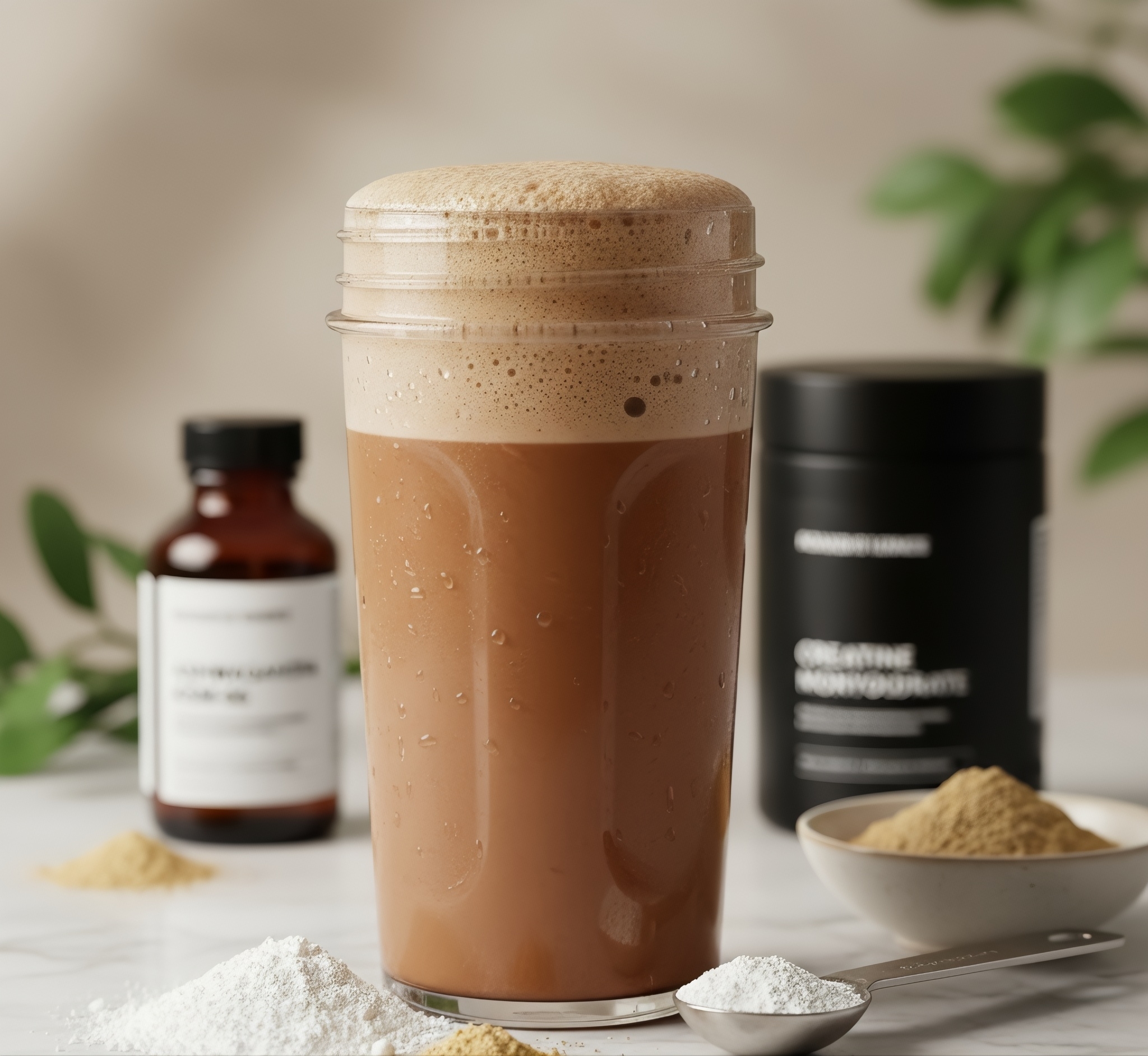
Creatine monohydrate remains the form with by far the largest body of research behind it.
Despite the proliferation of newer and more elaborate forms of creatine, plain old creatine monohydrate continues to be the standard.
For general use, 3 to 5 grams daily is a commonly studied maintenance amount.
Athletes sometimes use a loading phase of approximately 20 grams daily, divided into several doses for about a week, before dropping to a maintenance dose. For ordinary long-term supplementation, however, loading is not necessary. Consistent daily use will gradually increase tissue creatine stores.
WHAT ABOUT THE KIDNEYS?
This deserves clarification because creatine and creatinine sound alike for a reason.
Creatinine is a breakdown product of creatine. Taking creatine can therefore increase blood creatinine somewhat, which can complicate interpretation of creatinine-based estimates of kidney filtration.
An increase in creatinine in someone taking creatine does not automatically mean that creatine has damaged the kidneys.
Standard doses of creatine monohydrate have a substantial safety record in healthy people. Someone with existing kidney disease, however, is a different situation and should discuss supplementation with the appropriate healthcare professional.
MY TAKEAWAY
Creatine sits at the intersection of cellular energy, muscle preservation, physical function and brain energetics. For me, this has become another example of why it is worthwhile to periodically take a fresh look at something we think we already know.
Creatine is not just for bodybuilders.
ADDTIONAL RESOURCES

I talked about creatine in my Sept 19, 2026 Zoom Webinar as one of A Trio of Wonders. Click to find links to the video and PDF versions of the PowerPoint slides to view, download, share. The other two "wonders" are Astaxanthin and Alginic Acid. Curious? Check it out!
Advice & articles
-

ALGINIC ACID: Putting a Lid on Reflux!
20th Sep 2026I found it a bit of a sobering shock when a client told me just last week that she had discovered th
-
ASTAXANTHIN: The Powerhouse Pink Antioxidant!
20th Sep 2026As anyone who has known me for even a relatively short period of time knows, I am a glutathione enth
-

CREATINE: Not Just For Bodybuilders!
20th Sep 2026For the longest time, I thought of creatine, if not exclusively, at least primarily as a bodybuilder
- Read more articles